Prime RadiantPrime Radiant
Product

What Prime Radiant actually does

Six tools work side by side on every active Bittensor subnet — discovery, ranking, decision, validation, ongoing monitoring, and portfolio management. Below: each tool in detail, then the methodology that makes them defensible.

Last updated: May 21, 2026

Features

Six tools the AI team hands you

AI Board view in the Prime Radiant app: Fund Director's HOLD recommendation for SN25 Mainframe at 57% confidence, with executive summary, personalized action tied to the user's current position, and explicit entry / current / stop-loss / take-profit price levels.
AI Board · SN25 Mainframe · HOLD at 57% conviction
Decide with confidencePro

AI Board

Seven specialists · one thesis · with entry, target, and stop

When you want a complete analysis of any subnet, the AI Board runs the full team in parallel. Five analysts dig into their specialties — OnChain reads every snapshot, Fundamental runs Deep Research across 40 quality questions with cited sources, Sentiment watches Discord and Twitter, Graph maps team and partnership connections, Technical computes price structure for entry / target / stop. Their findings go through Data Guard, our skeptic — it validates every citation, flags hallucinated claims, and refuses analyses that don't hold up to scrutiny. Then Fund Director synthesizes everything into one decision: buy / hold / cut, with concrete entry, target, stop-loss, and a conviction score from 1 to 10. Every recommendation is persisted and auto-resolved against real market data every four hours — wins and misses, both published.

  • Parallel analyst execution Five specialists work simultaneously, full session typically completes in 60–90 seconds.
  • Data Guard validation Refuses outputs that fail citation or consistency checks before they reach you.
  • Persistent track record Every recommendation auto-resolved against real market data — track record is measurable, not anecdotal.
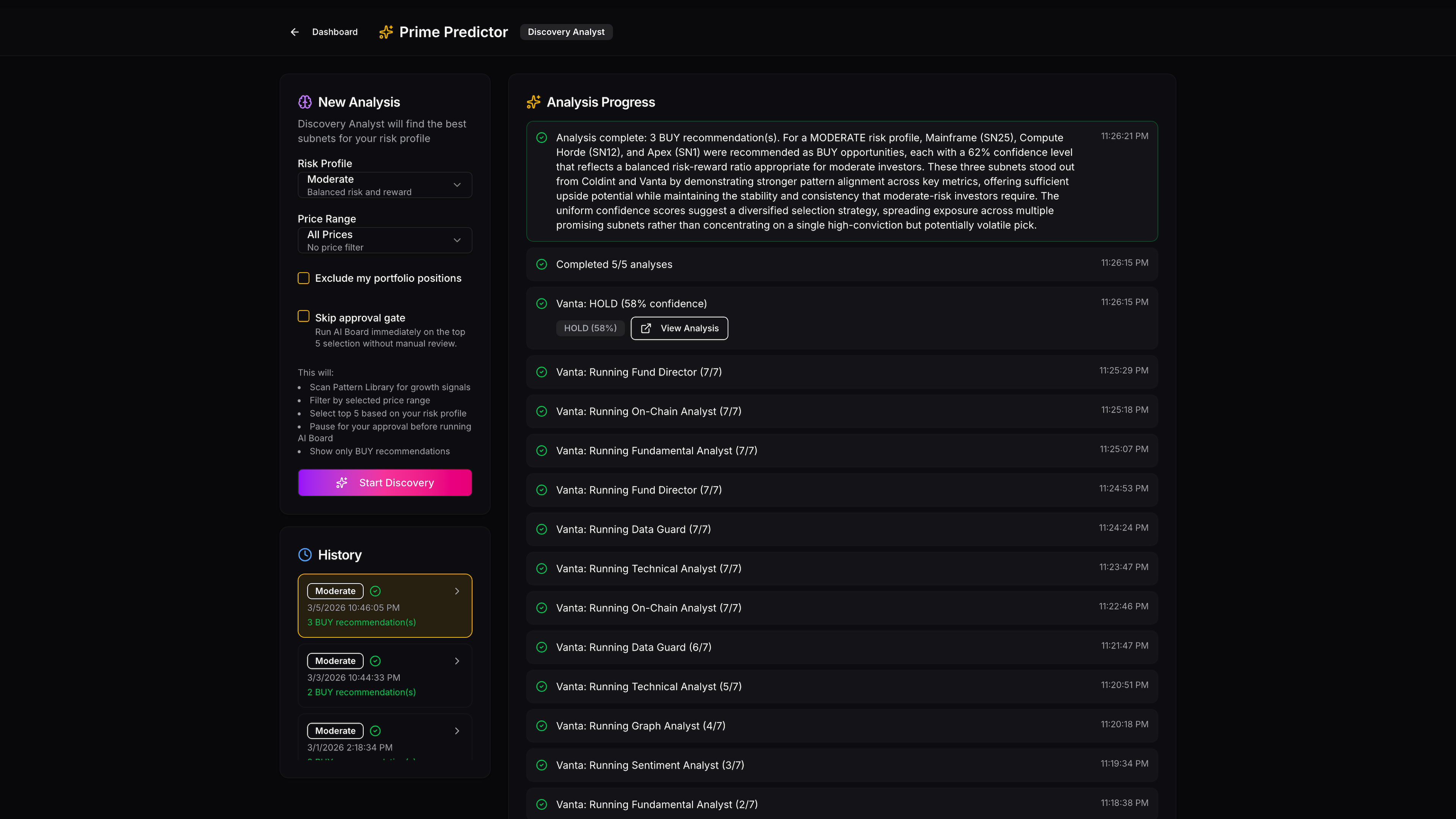
Prime Predictor view: left rail with the Discovery Analyst configuration form — risk profile, price range, exclude-portfolio toggle, skip-approval toggle — and a running Analysis Progress stream on the right showing the AI Board agents executing in sequence after approval, with the first verdict (Vanta · HOLD · 58% confidence) already resolved.
Prime Predictor · Discovery Analyst run · streaming agent progress after manual approval
Find vetted candidatesPro

Prime Predictor

Six safety gates · manual approval · zero LLM cost during pause

The failure mode of LLM-based subnet analysis is paying for tokens on candidates that should never have been considered. Prime Predictor scans every active subnet through a verified historical pattern dataset and ranks by accuracy, not raw confidence. Each survivor passes through six gates: dereg-risk gate filters subnets near deregistration; live-score gate drops anything with weak Onchain / Fundamental / Sentiment for the chosen risk profile (Conservative / Moderate / Aggressive); cooldown gate skips subnets recently analyzed without meaningful price movement; whale-pressure gate downranks subnets in caution or danger bands or eliminates them if top holders are actively dumping. Only the top five survivors are shown to you, with effective scores, whale chips, dereg badges, score chips, and cooldown context. The run pauses for manual approval; no LLM cost is incurred during the pause. After approval, the full 7-agent AI Board analysis runs on each approved candidate via SSE streaming, cancellable mid-stream.

  • Six independent safety gates Dereg-risk, live-score, cooldown, whale-pressure all filter before you spend a token.
  • Manual approval pause Zero LLM cost during the pause. You approve before the AI Board runs on candidates.
  • SSE streaming with cancel Watch the AI Board reason in real time, cancel mid-stream with no orphan calls.
Whale Tracker overview: header KPIs for 128 subnets tracked, 280,005 holders, 39/100 average WPS, and 54 caution / 6 danger counts; ranked subnet list sorted by WPS ascending with danger and caution band badges, holder counts, top-5 concentration percentages, and largest-wallet TAO size for each row.
Whale Tracker · 128 subnets · 54 caution / 6 danger · sorted by WPS
Find your edgeUnlimited

Whale Tracker

Whale Pressure Score 0–100 · five bands · per subnet, every four hours

Whales rotate out before they dump. Cohorts shift before prices move. Whale Tracker turns the top 200 holders of every subnet into a single health metric: Whale Pressure Score, 0–100, where higher is healthier. Four components feed the composite. Distribution Score measures ownership concentration via HHI and Gini with top-1 share as tiebreaker. Cohort Flow Score tracks signed net flows across five wallet cohorts — validator, whale, owner, retail, unknown — over 24h, 7d, and 30d. Free Float Score captures the health of staked-versus-liquid supply. Dormancy Score detects long-dormant coldkeys waking up to sell, using ADD z-scores. The composite drops into five bands: healthy / stable / watch / caution / danger. Each band automatically influences Predictor candidate scores and AI Board confidence.

  • Cohort labeling that doesn't lie Validators identified by owner-coldkey registry, not delegation patterns; owner-team coldkeys auto-resolved.
  • Team Stake metric See the absolute TAO position held by the subnet's owning team.
  • Danger band Telegram digest Twice daily, every subnet in danger band is flagged proactively.
Portfolio main view for a connected wallet: τ403.79 total balance worth $116.16k, full-period TAO and USD overlay timeline chart, Realized P&L by Month row, KPI cards for total balance, free TAO, staked as Alpha, staked as Root, unrealized P&L (+48.4041 τ, +14.15%), realized P&L (+58.6284 τ), and daily rewards, with the Alpha Token Positions table starting below.
Portfolio · lot-level P&L · TAO and USD valuation over the full holding period
Portfolio Position Overview tab: AI-generated diversification summary across 28 positions, a multi-item Action Plan with concrete buy / sell / hold steps tied to specific subnets and sizes, Free TAO panel, and a Predictor Insight section linking individual positions back to live Predictor signals.
Portfolio · Position Overview · AI-generated action plan and per-position Predictor insight
Manage your capitalPro

Portfolio Analytics

Lot-based P&L · AI rebalancing · track record per wallet

Add view-only SS58 addresses — no private keys, ever — and your portfolio becomes the AI team's workspace. Every position is tracked at the lot level: each (netuid, hotkey) pair maintains its own lots, partial sells compute realized P&L correctly, the open lot tracks unrealized P&L with weighted-average cost basis. The Portfolio Advisor agent looks at your full portfolio in context and produces an action plan: specific buy / sell / hold actions per position with reasoning, as toggleable to-dos. Price-zone alerts auto-route to Telegram when a position crosses critical levels. Every AI Board recommendation made for your wallets is tracked at the AI Track Record view — outcomes auto-resolved against real market data. You see what worked, what didn't, and where current price sits relative to the original entry / target / stop.

  • Lot-based realized P&L Partial sells handled correctly, no cost-basis confusion.
  • Rebalancing action items Specific actions per position, not vague advice.
  • Per-wallet track record See how the AI team performed on your actual capital, not a backtest.
Knowledge Graph view: force-directed network diagram of the Bittensor ecosystem with subnets, persons, companies, and funds rendered as color-coded nodes (1238 entities, 1721 relations); side panel shows the entity-type legend and aggregate statistics.
Knowledge Graph · 1,238 entities · 1,721 cited relations
Map the network

Knowledge Graph

Subnets, teams, partnerships · every edge cited · weekly rebuild

Bittensor isn't just a list of subnets — it's a network of teams, projects, and dependencies. The Knowledge Graph turns that network into a queryable structure. Entities cover subnets, teams, individual contributors, projects, and partners. Edges describe relationships like founded by, invested in, depends on, competes with. Every entity property and every edge has a source link, pulled from Deep Research outputs and curated mentions via OpenAI GPT-5 nano. The graph rebuilds weekly with versioned snapshots so you can see how the network shifts. The Graph Analyst agent inside the AI Board uses this structure to flag partnership concentration, dependency risk, and competitive overlap when scoring any individual subnet.

  • Cited edges only Every relationship has a source link — no edge in the graph is unsupported.
  • Weekly versioned rebuild Snapshots let you see how the Bittensor network shifts week over week.
  • Wired into AI Board scoring The Graph Analyst uses this structure to flag concentration and dependency risk.
Prime Radiant main dashboard listing every active Bittensor subnet with on-chain, sentiment, fundamentals, WPS, price and flow metrics side by side, with the user's saved wallet and Pro subscription context surfaced in the top-right strip and the Graph / AI Board / Predictor / Whales / Portfolio entry points along the top.
Dashboard · every active subnet · 12 sortable columns · wallet positions inline
See the whole market

Dashboard Signals

Every active subnet in one screen · 12 sortable columns · live wallet context

The Dashboard is where you start. Every active Bittensor subnet on one screen, with 12 sortable columns — onchain score, fundamental score, sentiment score, WPS band, dereg risk, price, 24h flow, 7d flow, APY, holder count, market cap, last analysis age. When you've added view-only wallets, your positions are highlighted inline so you can see at a glance which subnets you hold are scoring well and which are flashing risk. Every signal on the Dashboard is the same one feeding the AI Board and the Predictor — no hidden second tier. Free during early access on Watcher tier; full per-column drill-down on Pro and Unlimited.

  • 12 sortable columns Onchain, fundamental, sentiment, WPS, dereg, price, flows, APY, holders, mcap, last-analysis.
  • Inline wallet context Your positions highlighted on the same screen as every signal — no app-switching.
  • Same data the agents see Dashboard isn't a different view — it's the agents' input surface.
Ready to put the team to work

Your AI hedge fund, on your wallet

Add a view-only Bittensor address. The nine-agent team starts on your positions in under a minute — no private keys, ever.

Free during early access · View-only wallets, no private keys · Cancel anytime

Under the hood

The methodology underneath

Four structural pieces that make every feature defensible — pipelines, signal architecture, statistical validation, and how we handle the worst case (subnets dying).

Data sources

We poll on-chain data, holder cohorts, validator delegation and pool snapshots from Taostats and tao.app every four hours. How it works: snapshots are stored verbatim — we never overwrite history, so any number on the site can be replayed for the date it was computed. Discord and Twitter sentiment metrics come from tao.app’s sentiment endpoint, refreshed every twelve hours.

Why this matters: when a fire is recorded today and resolves in 30 days, the resolution is checked against the same forward snapshots every visitor will see — not a re-fetched view that may have been overwritten upstream.

H-003 multi-family signal

One-line summary: the strictest layer — only fires when several independent signal families agree.

How it works: each fire is recorded immediately with its forward-window timestamps (30d, 60d, 90d). Precision is reported per window once a fire matures (i.e. its forward window has closed). The gate is a separate switch that lets us disable the signal in production if drift is detected; while idle, no new fires are produced, but historical precision continues to be reported. H-003 has been through 1,000-permutation backtest acceptance gates — see backtests. We never backfill, retroactively relabel, or remove past fires.

Why this matters: single-indicator alerts are noisy by construction. By requiring agreement across independent families, H-003 trades volume for precision — the rarer the fire, the more information each fire carries. The H-003 badge surfaced in the dashboard uses the same gate.

Backtests — p-values & permutation nulls

One-line summary: every signal we publish has a permutation-null backtest run alongside it, so we can quote a p-value rather than a number-out-of-the-air precision.

How it works: for each signal, we build a null model by shuffling the labels (or by using a date-aligned permutation that preserves the autocorrelation structure) and re-running the same gating logic thousands of times. The fraction of permutation runs that beat the live signal’s observed precision is the p-value. Backtests are anti-leak by construction: they only ever see data that existed at the point a fire would have been recorded.

Why this matters: on a small sample, almost any signal can look impressive. A p-value tells you how likely the live number is to be coincidence; permutation nulls tell you what “coincidence” actually looks like for this data, not a textbook distribution.

Deregistration handling

One-line summary: when a subnet deregisters and later re-registers under a new netuid, we detect it via three independent paths so its history is not orphaned.

How it works: the three paths are (1) team identity continuity from the fundamentals research, (2) wallet-cohort continuity from the on-chain side, and (3) social handle continuity from sentiment. When at least two of the three agree on a re-registration, the subnet’s historical fires and patterns are linked to the new netuid, with the deregistration gap visible in the audit trail. Fires recorded under the previous netuid are not deleted or re-scored.

Why this matters: deregistration is one of the most common ways for a subnet’s recent track record to vanish. Recovering the link without rewriting history is what lets the published precision survive that event.

What we don’t do

  • We do not recommend wallet allocations or position sizes.
  • We do not publish per-subnet recommendations on this landing page.
  • We do not back-fit metrics. New patterns and signals only enter scoring once they have been added to the registry; old fires are never relabelled.

Caveats

Past precision is not a guarantee of future precision. Bittensor subnets are an early, illiquid market with thin order books and meaningful idiosyncratic risk. See the risk disclosure for the full version.